Table Of Content

He approaches it more than once, using the preciseidea, and almost the language too, of the Nebraska act. Put this and that together, and we have another nice little niche,which we may, ere long, see filled with another Supreme Court decision,declaring that the Constitution of the United States does not permit aState to exclude slavery from its limits. And this may especially beexpected if the doctrine of "care not whether slavery be voted down orvoted up" shall gain upon the public mind sufficiently to give promisethat such a decision can be maintained when made.
Explore the National Park Service
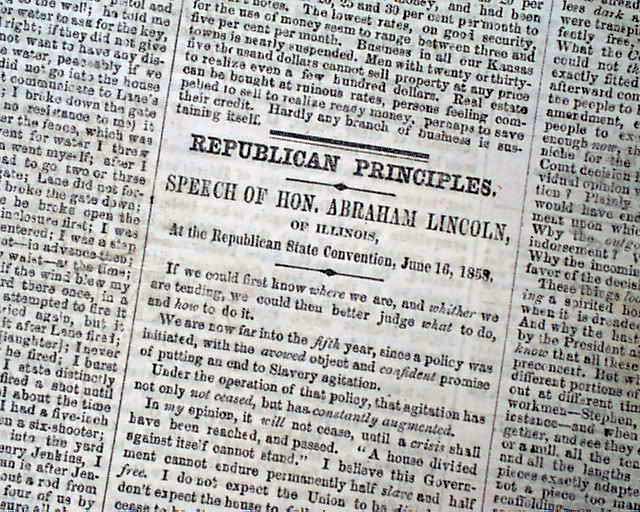
If we could first know where we are and whither we are tending, we could better judge what to do and how to do it. We are now far into the fifth year since a policy was initiated with the avowed object and confident promise of putting an end to slavery agitation. Under the operation of that policy, that agitation has not only not ceased but has constantly augmented. In my opinion, it will not cease until a crisis shall have been reached and passed.
Lincoln’s Writings
Under the Dred Scott decision, "squatter sovereignty" squatted out of existence, tumbled down like temporary scaffolding -- like the mould at the foundry served through one blast and fell back into loose sand -- helped to carry an election, and then was kicked to the winds. While the Nebraska Bill was passing through congress, a law case involving the question of a negroe's freedom, by reason of his owner having voluntarily taken him first into a free state and then a territory covered by the congressional prohibition, and held him as a slave, for a long time in each, was passing through the U.S. Circuit Court for the District of Missouri; and both Nebraska bill and law suit were brought to a decision in the same month of May, 1854. The negroe's name was "Dred Scott," which name now designates the decision finally made in the case.
Abraham and Mary Lincoln: A House Divided American Experience - PBS
Abraham and Mary Lincoln: A House Divided American Experience.
Posted: Wed, 13 Apr 2016 18:41:43 GMT [source]
Lincoln, House Divided speech (
The Morehouse announcement has drawn some backlash among the school’s faculty and supporters who are critical of Biden’s handling of the Israel-Hamas war. That could put the White House and Biden’s re-election campaign in a difficult position as the president works to shore up the racially diverse coalition that propelled him to the Oval Office. Such a decision is all that slavery now lacks of being alike lawful in all the states. Thirdly, that whether the holding a Negro in actual slavery in a free state, makes him free, as against the holder, the United States courts will not decide, but will leave to be decided by the courts of any slave state the Negro may be forced into by the master. The reputed author of the Nebraska bill finds an early occasion to make a speech at this capital endorsing the Dred Scott decision, and vehemently denouncing all opposition to it. Mr. Buchanan[8] was elected, and the endorsement, such as it was, secured.
"A record of the personal services of our American women in the late Civil War"
Let any one who doubts, carefully contemplate that now almost complete legal combination - piece of machinery so to speak- compounded of the Nebraska doctrine, and the Dred Scott decision. It should not be overlooked that by the Nebraska bill the people of aState as well as Territory were to be left "perfectly free," "subjectonly to the Constitution." Why mention a State? They were legislatingfor Territories, and not for or about States.
Abraham Lincoln's "House Divided" Speech
Two years ago the Republicans of the nation mustered over thirteen hundred thousand strong. We did this under the single impulse of resistance to a common danger, with every external circumstance against us. Of strange, discordant, and even hostile elements, we gathered from the four winds, and formed and fought the battle through, under the constant hot fire of a disciplined, proud, and pampered enemy. —now, when that same enemy is wavering, dissevered, and belligerent?
Questions for Discussion
In what cases the power of the states is so restrained by the United States Constitution, is left an open question, precisely as the same question, as to the restraint on the power of the territories, was left open in the Nebraska act. Put this and that together, and we have another nice little niche, which we may, ere long, see filled with another Supreme Court decision, declaring that the Constitution of the United States does not permit a state to exclude slavery from its limits. “But,” said opposition members, “let us amend the bill so as to expressly declare that the people of the territory may exclude slavery.” “Not we,” said the friends of the measure; and down they voted the amendment. And this may especially be expected if the doctrine of "care not whether slavery be voted down or voted up, shall gain upon the public mind sufficiently to give promise that such a decision an be maintained when made. In what cases the power of the states is so restrained by the U.S. We can not absolutely know that all these exact adaptations are the result of preconcert.
Understanding Lincoln Online Course
“A house divided against itself cannot stand.” I believe this government cannot endure, permanently half slave and half free. Secondly, that “subject to the Constitution of the United States,” neither Congress nor a Territorial Legislature can exclude slavery from any United States territory. This point is made in order that individual men may fill up the territories with slaves, without danger of losing them as property, and thus to enhance the chances of permanency to the institution through all the future.
Political Parties
Can we safely base our action upon any such vague inference? - now - when that same enemy is wavering, dissevered, and belligerent? We shall not fail-if we stand firm, we shall not fail.Wise counsels may accelerate or mistakes delay it, but sooner or later the victory is sure to come. I believe this government cannot endure, permanently half slave and half free.
Under the Dred Scott decision, "squatter sovereignty" squatted out of existence, tumbled down like temporary scaffolding; like the mold at the foundry, served through one blast and fell back into loose sand; helped to carry an election and then was kicked to the winds. That struggle was made on a point — the right of a people to make their own constitution — upon which he and the Republicans have never differed. Auxiliary to all this, and working hand in hand with it, the Nebraska doctrine, or what is left of it, is to educate and mould public opinion, at least Northern public opinion, not to care whether slavery is voted down or voted up. Either the opponents of slavery, will arrest the further spread of it, and place it where the public mind shall rest in the belief that it is in course of ultimate extinction; or its advocates will push it forward, till it shall become alike lawful in all the States, old as well as new—North as well as South. Auxiliary to all this, and working hand in hand with it, the Nebraska doctrine, or what is left of it, is to educate and mold public opinion, at least Northern public opinion, not to care whether slavery is voted down or voted up.
He called for safeguarding democratic values as the “authoritarian model” was becoming “more popular” across the continent. Referring to trade practices of China and the U.S., Macron said “the two world powers have decided not to respect the rules of global trade” by shoring up protections and subsides while Europe’s industry remains open and is stuck in overregulation. France has been a firm supporter of Ukraine in its fight against Russian aggression, and Macron has often clashed with other Western leaders as he has insisted that Europe must stand by the country at any cost. The French president alarmed European leaders by saying recently that sending Western troops into Ukraine to shore up its defenses shouldn’t be ruled out. Russia’s full-scale invasion of Ukraine, now in its third year, is an existential threat and Europe isn’t armed enough to defend itself when “confronted by a power like Russia that has no inhibitions, no limits,” Macron said.
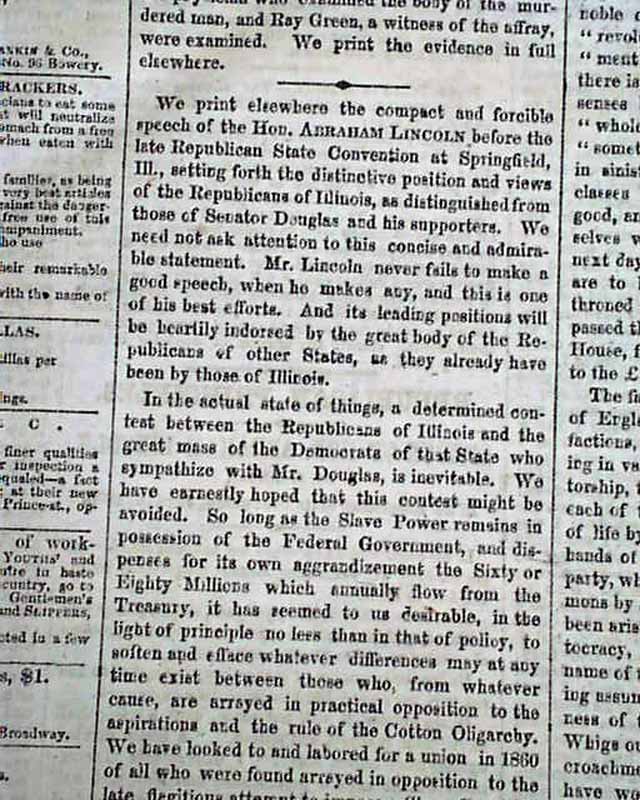
At length a squabble springs up between the president and the author of the Nebraska bill, on the mere question of fact, whether the Lecompton Constitution was or was not, in any just sense, made by the people of Kansas; and in that quarrel the latter declares that all he wants is a fair vote for the people, and that he cares not whether slavery be voted down or voted up. I do not understand his declaration that he cares not whether slavery be voted down or voted up, to be intended by him other than as an apt definition of the policy he would impress upon the public mind—the principle for which he declares he has suffered so much, and is ready to suffer to the end. Abraham Lincoln delivered his famous “House Divided” speech on the evening of June 16, 1858 at the Illinois Republican State Convention in Springfield, Illinois. Earlier that day, Illinois Republicans had adopted an unprecedented endorsement for the local attorney and former congressman as their “first and only choice” in the forthcoming campaign to unseat incumbent Senator Stephen A. Douglas. The reason why such an endorsement was unusual was because in those days there was no tradition of public campaigning for US senate seats.
Before the ratification of the 17th amendment in 1912, state legislatures always selected US senators and would-be candidates typically conducted their efforts in private and after the fall legislative elections. But Lincoln’s Republican allies believed it was critical to organize an early public campaign with him as the the party’s official nominee in order to head off growing pressure on them to support Douglas, a leading Democrat. The pressure was coming because Douglas was in the midst of a bitter feud with President James Buchanan, the more openly pro-slavery leader of his national party. To some Republicans, especially party leaders from New York, this Democratic feud represented a rare opportunity to flip an old political enemy. Yet Lincoln and the Illinois Republicans knew all too well that Douglas was not committed to their core antislavery positions –most notably their firm belief in stopping slavery’s expansion into western territories such as Kansas.
The new year of 1854 found slavery excluded from more than half the states by state constitutions and from most of the national territory by congressional prohibition. Four days later commenced the struggle which ended in repealing that congressional prohibition. This opened all the national territory to slavery and was the first point gained.
Two years ago the Republicans of thenation mustered over thirteen hundred thousand strong. We did this underthe single impulse of resistance to a common danger, with every externalcircumstance against us. Of strange, discordant, and even hostileelements, we gathered from the four winds, and formed and fought thebattle through, under the constant hot fire of a disciplined, proud, andpampered enemy. --now, when thatsame enemy is wavering, dissevered, and belligerent? Wisecounsels may accelerate or mistakes delay it; but sooner or later thevictory is sure to come.
[12] The new year of 1854 found slavery excluded from more than half the States by State Constitutions, and from most of the national territory by Congressional prohibition. “Anybody who would allow innocent people to be killed to preserve their political career to win an election does not deserve to win,” said state Rep. Alex Kolodin (R), who sees the 1864 law as a victory for the party’s core ideological position as well as a major humanitarian triumph. In recent days, Lake, who once described the 160-year-old measure as a “great law,” has been personally lobbying some Republicans to repeal the ban, highlighting the political stakes of the looming vote.




No comments:
Post a Comment